Monday, 26 December 2016

Cyanogen failed to kill Android, now it is shuttering its services and OS as part of a pivot


It’s been a rocky few months for Cyanogen, the ambitious startup that aimed to build a better version of Android than Google. It has laid off staff, let go of its CEO and parted ways with another co-founder — now it is shutting down its services and nightly software builds on December 31.
The news was announced in a brief blog post released late on Friday:
As part of the ongoing consolidation of Cyanogen, all services and Cyanogen-supported nightly builds will be discontinued no later than 12/31/16. The open source project and source code will remain available for anyone who wants to build CyanogenMod personally.
This update means owners of a device that runs the Cyanogen OS — such as the OnePlus One — must now transition over to the CyanogenMod ROM, which is not a commercial product and is managed by a community of developers led by former co-founder Steve Klondik.
This essentially marks the end of Cyanogen’s grand ambition. Outspoken former CEO Kirt McMaster once claimed his company was “putting a bullet through Google’s head,” but now it is transitioning to a different approach that new CEO Lior Tal believes will be more attractive to OEMs.
Tal, who was previously Cyanogen COO, described the new Cyanogen Modular OS program as “designed to achieve the original objective of an open and smarter Android without the limitations of requiring the full Cyanogen OS stack and individual device bring-ups.”
Essentially, Cyanogen has given up on killing Google and will instead adapt to live in Google’s world.
Its software was always a hard sell because it required handset makers to ditch Android and Google services entirely in favor of Cyanogen’s own alternatives. Then there was the politics. OnePlus was Cyanogen’s largest partner, but the relationship was strained and it ended on a sour note after just one device.
Now that these Cyanogen services are dying, Tal’s strategy is to unbundle what the Cyanogen OS did offer so that it can work in conjunction with regular Android builds and the stock services that Google provides with it.
“The new partnership program offers smartphone manufacturers greater freedom and opportunity to introduce intelligent, customizable Android smartphones using different parts of the Cyanogen OS via dynamic modules and MODs, with the ROM of their choice, whether stock Android or their own variant,” Lior said in a statement in October when he took his new role.
Cyanogen has raised $115 million to date from investors which include Andreessen Horowitz and Benchmark, according to Crunchbase. Lior said in late November that the company is “well funded,” yet it has spent half of the year in cost-cutting mode. It made made layoffs over the summer and recently shuttered its Seattle office in order to “consolidate” its workforce into one team based out of its base in Palo Alto. The closure of its services is a further cost-saving move that fits with its pivot to make it more accessible and less of commitment for prospective partners. The question now is whether it can offer anything that partners actually want and will pay for.

The NBA is launching its own fantasy game you can play while watching live basketball


While it’s clear that daily fantasy sports games like the ones offered by DraftKings and FanDuel make watching sports more exciting, they aren’t necessarily the best companion if you’re focused on watching one team play.
Let’s use The NFL as an example. Any given Sunday your daily fantasy sports team can have players from 9 different teams – potentially even playing in 9 different games, all live on different channels. Trying to keep up with watching your players and switch between channels is a nightmare.
So while daily fantasy sports can be a great fan engagement tool, it’s not the best second-screen experience to play while trying to just relax and watch one game on TV.
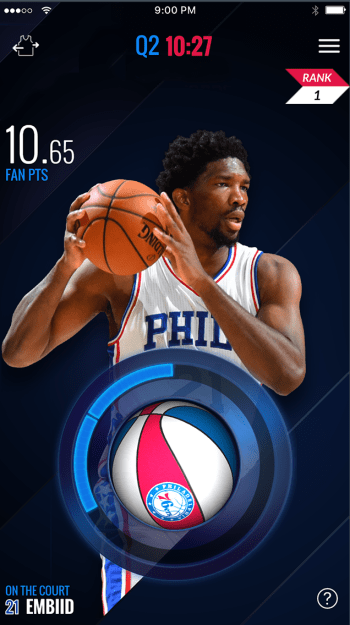
The NBA has realized this, and is launching a new mobile fantasy game called NBA InPlay. The game will be synchronized to live TV broadcasts in real-time, meaning you literally play live on your phone while watching an NBA Game.
Here are the rules: Before a game starts you select one of the two teams competing. Then you pick four players – one per each quarter that you think will do particularly well that quarter.
So I could choose Kevin Durant for the 1st quarter because I know he starts off hot, Steph Curry in the 2nd because that’s when I think he will shoot the most 3s, etc. You then accumulate points based on each player’s performance (points, rebounds, assists, etc) during the quarter you have them picked for. embiid
And here’s the real-time component: Each quarter users are granted four “turbo boosts” that they can activate. These boosts launch 48 seconds each and do two things – allow you to accumulate points based on the performance of everyplayer on your team, as well as give you extra points from the player you picked that quarter – both of which only happen during the 48 seconds after you activate a boost.
The NBA is emphasizing the real-time nature of “turbo boosts” – they literally want you to tap and activate it right before someone jumps to make a 3-pointer, or is running down the court on a fast break.
This hyper time-sensitive feature requires your actions to be in total sync with the game’s servers – which is tough considering TV broadcasts are delayed anywhere from 2-10 seconds depending on where you are watching.
So to fix this, NBA Digital detects a silent audio signature in all broadcasts – users grant access to their microphone so it can pick up the broadcast and synchronize their fantasy game with the real game on TV.
The game will launch tonight during the Los Angeles Lakers vs. Miami Heat game at 8pm on TNT, and will be available for every live nationally televised game (on TNT, NBA TV, ESPN and ABC) for the rest of the season – so you should have plenty of opportunities to play. You can either play in the general league with every other fan, or create a private league to just play with your friends.
And the game is free to play with no paid options – something that differentiates it from more traditional daily fantasy sports games, and allows the game to avoid any regulatory issues still surrounding the industry. There will be prizes though – the league will give away gift cards to the NBA Team Store to winners, as well as partner with sponsors to give things away like credit to buy a new car from Autotrader and tickets to the NBA Finals.
NBA InPlay was launched by NBA Digital, the group co-managed by the NBA and Turner Sports that is responsible for other digital innovations like League Pass and the partnership with NextVR.
However FanDuel, the popular daily fantasy sports company that will soon merge with DraftKings, helped NBA Digital develop the app “as part of the company’s efforts to innovate and diversify its offering of gaming options for fans”. The NBA invested in FanDuel in 2014 back when the industry was just beginning its rapid growth.
NBA InPlay is available now and you can download it and start playing tonight.

Blog Archive