Monday, 26 December 2016

Cyanogen failed to kill Android, now it is shuttering its services and OS as part of a pivot


It’s been a rocky few months for Cyanogen, the ambitious startup that aimed to build a better version of Android than Google. It has laid off staff, let go of its CEO and parted ways with another co-founder — now it is shutting down its services and nightly software builds on December 31.
The news was announced in a brief blog post released late on Friday:
As part of the ongoing consolidation of Cyanogen, all services and Cyanogen-supported nightly builds will be discontinued no later than 12/31/16. The open source project and source code will remain available for anyone who wants to build CyanogenMod personally.
This update means owners of a device that runs the Cyanogen OS — such as the OnePlus One — must now transition over to the CyanogenMod ROM, which is not a commercial product and is managed by a community of developers led by former co-founder Steve Klondik.
This essentially marks the end of Cyanogen’s grand ambition. Outspoken former CEO Kirt McMaster once claimed his company was “putting a bullet through Google’s head,” but now it is transitioning to a different approach that new CEO Lior Tal believes will be more attractive to OEMs.
Tal, who was previously Cyanogen COO, described the new Cyanogen Modular OS program as “designed to achieve the original objective of an open and smarter Android without the limitations of requiring the full Cyanogen OS stack and individual device bring-ups.”
Essentially, Cyanogen has given up on killing Google and will instead adapt to live in Google’s world.
Its software was always a hard sell because it required handset makers to ditch Android and Google services entirely in favor of Cyanogen’s own alternatives. Then there was the politics. OnePlus was Cyanogen’s largest partner, but the relationship was strained and it ended on a sour note after just one device.
Now that these Cyanogen services are dying, Tal’s strategy is to unbundle what the Cyanogen OS did offer so that it can work in conjunction with regular Android builds and the stock services that Google provides with it.
“The new partnership program offers smartphone manufacturers greater freedom and opportunity to introduce intelligent, customizable Android smartphones using different parts of the Cyanogen OS via dynamic modules and MODs, with the ROM of their choice, whether stock Android or their own variant,” Lior said in a statement in October when he took his new role.
Cyanogen has raised $115 million to date from investors which include Andreessen Horowitz and Benchmark, according to Crunchbase. Lior said in late November that the company is “well funded,” yet it has spent half of the year in cost-cutting mode. It made made layoffs over the summer and recently shuttered its Seattle office in order to “consolidate” its workforce into one team based out of its base in Palo Alto. The closure of its services is a further cost-saving move that fits with its pivot to make it more accessible and less of commitment for prospective partners. The question now is whether it can offer anything that partners actually want and will pay for.

The NBA is launching its own fantasy game you can play while watching live basketball


While it’s clear that daily fantasy sports games like the ones offered by DraftKings and FanDuel make watching sports more exciting, they aren’t necessarily the best companion if you’re focused on watching one team play.
Let’s use The NFL as an example. Any given Sunday your daily fantasy sports team can have players from 9 different teams – potentially even playing in 9 different games, all live on different channels. Trying to keep up with watching your players and switch between channels is a nightmare.
So while daily fantasy sports can be a great fan engagement tool, it’s not the best second-screen experience to play while trying to just relax and watch one game on TV.
The NBA has realized this, and is launching a new mobile fantasy game called NBA InPlay. The game will be synchronized to live TV broadcasts in real-time, meaning you literally play live on your phone while watching an NBA Game.
Here are the rules: Before a game starts you select one of the two teams competing. Then you pick four players – one per each quarter that you think will do particularly well that quarter.
So I could choose Kevin Durant for the 1st quarter because I know he starts off hot, Steph Curry in the 2nd because that’s when I think he will shoot the most 3s, etc. You then accumulate points based on each player’s performance (points, rebounds, assists, etc) during the quarter you have them picked for. embiid
And here’s the real-time component: Each quarter users are granted four “turbo boosts” that they can activate. These boosts launch 48 seconds each and do two things – allow you to accumulate points based on the performance of everyplayer on your team, as well as give you extra points from the player you picked that quarter – both of which only happen during the 48 seconds after you activate a boost.
The NBA is emphasizing the real-time nature of “turbo boosts” – they literally want you to tap and activate it right before someone jumps to make a 3-pointer, or is running down the court on a fast break.
This hyper time-sensitive feature requires your actions to be in total sync with the game’s servers – which is tough considering TV broadcasts are delayed anywhere from 2-10 seconds depending on where you are watching.
So to fix this, NBA Digital detects a silent audio signature in all broadcasts – users grant access to their microphone so it can pick up the broadcast and synchronize their fantasy game with the real game on TV.
The game will launch tonight during the Los Angeles Lakers vs. Miami Heat game at 8pm on TNT, and will be available for every live nationally televised game (on TNT, NBA TV, ESPN and ABC) for the rest of the season – so you should have plenty of opportunities to play. You can either play in the general league with every other fan, or create a private league to just play with your friends.
And the game is free to play with no paid options – something that differentiates it from more traditional daily fantasy sports games, and allows the game to avoid any regulatory issues still surrounding the industry. There will be prizes though – the league will give away gift cards to the NBA Team Store to winners, as well as partner with sponsors to give things away like credit to buy a new car from Autotrader and tickets to the NBA Finals.
NBA InPlay was launched by NBA Digital, the group co-managed by the NBA and Turner Sports that is responsible for other digital innovations like League Pass and the partnership with NextVR.
However FanDuel, the popular daily fantasy sports company that will soon merge with DraftKings, helped NBA Digital develop the app “as part of the company’s efforts to innovate and diversify its offering of gaming options for fans”. The NBA invested in FanDuel in 2014 back when the industry was just beginning its rapid growth.
NBA InPlay is available now and you can download it and start playing tonight.

Friday, 23 December 2016

The new Barnes & Noble Nooks come with free malware

Barnes & Noble began outsourcing its Nook e-readers a few years ago after a partnership with Samsung and their latest $50 Nook 7 android tablet, announced last month, shows us how that has worked out for them. Their latest e-reader includes ADUPS, a firmware that sends user data back to the manufacturer or an interested hacker. This is the same malware that researchers found on cheap Blu tablets and phones last month.
The manufacturer claims to have patched the malware in current products but it seems the new B&N Nooks are still running the old software. ADUPS allows for full data access on the device and command and control privileges including remote software installation and automatic updates without use permission.
How bad is it?
These devices actively transmitted user and device information including the full-body of text messages, contact lists, call history with full telephone numbers, unique device identifiers including the International Mobile Subscriber Identity (IMSI) and the International Mobile Equipment Identity (IMEI). The firmware could target specific users and text messages matching remotely defined keywords. The firmware also collected and transmitted information about the use of applications installed on the monitored device, bypassed the Android permission model, executed remote commands with escalated (system) privileges, and was able to remotely reprogram the devices… The firmware that shipped with the mobile devices and subsequent updates allowed for the remote installation of applications without the users’ consent and, in some versions of the software, the transmission of fine-grained device location information.
The Digital Reader is recommending that users return their Nooks and notes that B&N has a holiday return policy that lets you send items back until January 31.

Uber stops San Francisco self-driving pilot as DMV revoked registrations

Uber has confirmed that it will stop its self-driving pilot in San Francisco, following a meeting today with the California DMV and Attorney General’s office. The DMV revoked the registration on 16 self-driving test vehicles Uber was using in its pilot.
The DMV tells TechCrunch that it invited Uber to complete its permitting process at the same time it revoked it the vehicle registrations. Uber told TechCrunch that it will instead be looking to deploy the vehicles elsewhere for the time being. Here’s Uber’s statement on the matter in full:
We have stopped our self-driving pilot in California as the DMV has revoked the registrations for our self-driving cars. We’re now looking at where we can redeploy these cars but remain 100 percent committed to California and will be redoubling our efforts to develop workable statewide rules.
Uber had begun updating self-driving Volvo X90 SUVs in San Francisco on December 14, providing service to randomly selected uberX customers in the area. It chose not to pursue the permit the state issues to companies for testing autonomous vehicles on public roads, arguing that its cars didn’t require such permits as they could not operate completely autonomously at this stage.
While initially Uber continued its pilot even in the face of regulatory objections, both the DMV and California’s Attorney General’s office said that Uber would face legal repercussions, including injunctive action, if they maintained the active service.
Uber currently operates another trial of its self-driving technology, in Pittsburgh, where its Advanced Technology Group is based. Those trials, which began earlier this year, use Ford Focus vehicles retrofitted with autonomous sensors and onboard computing, and will continue.

Wednesday, 21 December 2016

Uber losses expected to hit $3 billion in 2016 despite revenue growth


Uber’s losses are growing from $2.2 billion last year to an expected $3 billion this year, according to multiple reports this week from The Information and others.
It’s hard to fathom Uber operating so far from profitability at a time when it feels like an established mainstream brand on the global stage.
Hip hop stars like Drake or Wiz Khalifa commonly name check Uber now in their lyrics, and multiple Hollywood studios have signed big names, including Will Ferrell,  to produce and star in comedies about Uber drivers.
The ride hailing pioneer is expected to surpass $5.5 billion in net revenue in 2016, according to a Bloomberg report, up from an estimated $2 billion in revenue last year.
While that kind of sales growth is normally impressive, considering the $3 billion in anticipated losses, Uber is apparently spending $1.55 for every dollar it makes.
An Uber spokesperson said the company does not comment on its financials.
Here’s where we know Uber has spent some of that scratch: developing self-driving vehicles, growing its food delivery business, paying drivers and employees, and a lot of affiliated lawsuits and lobbying.
Human drivers remain a serious cost center for Uber, even as the company has shifted its compensation practices over the years to lower the cost of every trip it makes.
Besides having to pay drivers, Uber has to fight competitors to keep them working  within the Uber marketplace, which takes incentives, bonuses, advertising and a solid driver-side mobile app.
Of course, Uber has also spent money defending itself in multiple lawsuits filed by drivers around employment classification and more.
The company also reportedly spent hundreds of millions on improving its map-tech so it won’t have to rely on outside partners for its navigation systems and location data.
This year, Uber continued to make strategic acquisitions as well, buying up artificial intelligence startup Geometric Intelligence, and self-driving truck startup Otto, in a quest to become a leader in autonomous vehicles and logistics.
But as those acquisitions were taking shape, bookings slowed down for Uber towards the end of 2016.
That was to be expected, as soon as Uber backed off its efforts to compete in China. It merged its business there with that of Didi Chuxing, its strongest regional competitor, in exchange for a stake in the combined entity.
Though it meant fewer trips taken by Uber worldwide, that move freed up the company to focus on other initiatives like ramping up its UberEATS food delivery service to more than 50 cities.
Uber’s efforts to develop and test self-driving vehicles in Pittsburgh and most recently San Francisco are probably a bigger hit to the company’s bottom line.
Since autonomous vehicles could one day allow Uber to operate fleets with few or possibly no human drivers, it seems likely that investors will continue to support the company’s spending there.
But at the same time, competitors are flocking into this space, making the cost of recruiting and retaining talent sky high in a way it simply wasn’t before Google turned its self-driving car project into a full-fledged business unit called Waymo.
Because most of its competitors are also privately held companies— including Lyft in the U.S., Ola in India, Grab in Southeast Asia, and Gett in Europe—  it’s hard to know how Uber’s spending stacks up versus competitors precisely.
However, ridehailing industry insiders believe Uber is still spending more wisely on the ridesharing portion of its business than U.S. competitors Lyft. One person familiar with both companies’ financials told TechCrunch that Lyft spends some 50% more per trip than Uber does, namely giving discounts and promotions to riders and incentives to drivers.

OurMine hacks Netflix, Marvel Twitter accounts


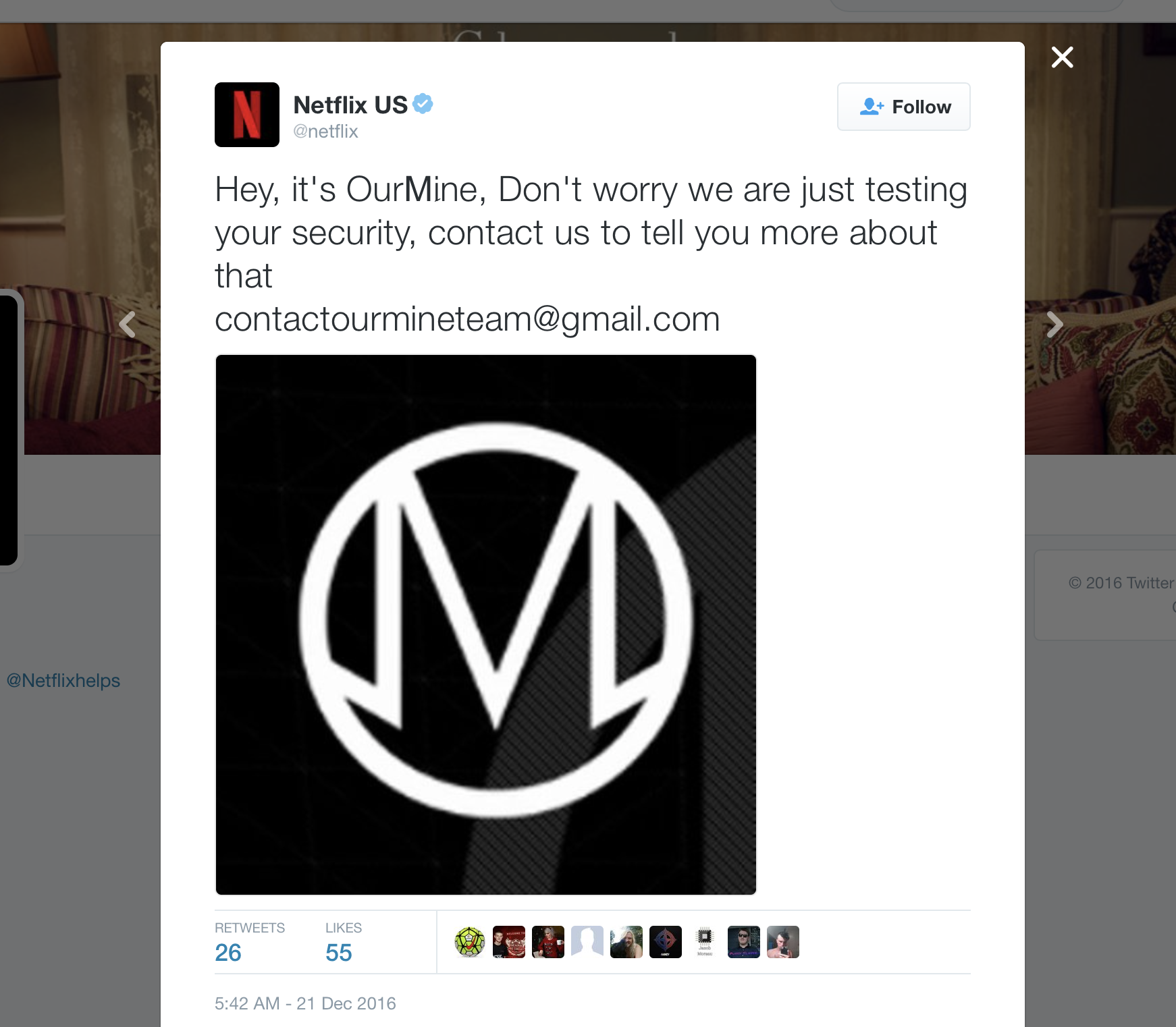
OurMine is up to its old tricks again, with an attack on Netflix’s official U.S. Twitter account. The hacking team has been responsible for taking over a number of high-profile Twitter accounts during the past year or so, including Google’s Sundar Pichai, actor Channing Tatum – and us, TechCrunch dot com.
The team is made up of a small group of young people (one of whom might be a  Saudi teen) according to an investigation by our own Kate Conger, and their stated mission is to test the strength of passwords for accounts with a lot of followers and potential influence. OurMine typically doesn’t do much once it gains access to an account, short of posting messages advising the account’s owner to contact them via an email address for more info about how to put better security practices in place.
screen-shot-2016-12-21-at-8-44-39-am
OurMine seems to operate by testing various accounts belonging to these high-profile vulnerabilities for use of weak passwords, which may have been leaked in previous credential dumps resulted from hacks like the LinkedIn password breach from earlier this year. The hacking group might take control of a target’s Twitter account or website directly, or could exploit connected apps and services to push content to those destinations indirectly.
Netflix’s Twitter account had posted a number of OurMine-created messages as of this morning, with its actual social team clearly moving to delete them as quickly as possible. Even changing your primary password might not prevent access in instances like this, because of previously authorized apps connected to Twitter – it’s a good idea to occasionally check what apps are authorized to access your account and shut down ones that aren’t necessary.
Update: Marvels’ Twitter account was also taken over by OurMine later on Wednesday, with a similar message posted about reaching out for help regarding their security. Again, this is likely due to password reuse from leaked credentials – so change those if you think you might be in the same boat.

Super Mario Run breaks records with 40 million downloads in its first 4 days


Nintendo has confirmed what we all knew was likely – Super Mario Run got a lot of downloads at launch. The company says that the app was downloaded over 40 million times during its first four days on the App Store, which breaks records for Apple’s mobile software shop. Previous third-party estimates suggested the new game was on track to topple Pokémon Go’s previous early performance and approach the 40 million mark, but this official number confirms it.
In a press release issued by Nintendo, the company says that in addition to its top ranking in the “free” chart of the App Store in 140 different global markets (of the 150 where it’s available), it’s also now in the top 10 ranking for best grossing games in 100 different markets.
Apple SVP of Marketing Phil Schiller is quoted in the release, confirming that the game broke a record for App Store downloads during its initial few days of availability. Nintendo closes the record announcement with a note that it believes its achieving its goal of growing the group of customers who are familiar with its IP even further.
The release also notes that Nintendo is making it easier to enjoy all modes as much as possible following the initial purchase, and a recent feature update indeed now allows you to run head-to-head with friends without using tickets, which are normally required for the Toad Rally.

Here’s our first look at Waymo’s new self-driving Chrysler Pacifica minivans


Waymo, the newly-minted Alphabet company that was previously Google’s self-driving car project, has a new addition to its vehicle fleet: 100 Chrysler Pacifica hybrid minivans, which were produced by Fiat Chrysler specifically for the purpose of making them fully autonomous using Waymo’s tech, onboard computer power, sensors and telematics. The 100 new cars will join Waymo’s other self-driving vehicles in active service on public roads for more testing starting early next year.
These vehicles were created through a close partnership between Waymo and FCA that actually saw engineering teams from both companies co-located at a Michigan engineering site, and testing of tech through the development process happened both in Chelsea, Michigan, and Yucca, Arizona on the FCA side, and at Waymo’s own test facilities in California.
While the Chrysler Pacificas used are based on the 2017 production model that consumers can buy, changes were made to the vehicles’ electrical, powertrain and structural systems, as well as to the vehicle chassis itself, in order to make them better suited for using Waymo’s tech. This results in a much tighter integration than if the Alphabet company had just purchased Chrysler vehicles off the line and done their own aftermarket modifications on stock vehicles. Still, from project outset to these being ready to enter service took only six months, according to FCA.
In a blog post, Waymo CEO John Krafcik noted that the addition of the Pacifica, with its minivan form factor, to their test fleet, helps better represent the full range of vehicles and passenger needs among its range of self-driving vehicles. Prototypes in private tests have actually already seen a range of tests, including over 200 hours exposed to extreme weather, Krafcik says in the blog post.
Bloomberg recently reported that Waymo is working with Fiat Chrysler on a larger fleet deployment of semi-autonomous Chrysler Pacifica vehicles for a ride-sharing service open to consumers, which could debut as early as next year. These 100 vehicles were previously announced by Fiat Chrysler and the Alphabet company earlier this year for testing, but any larger service launch will require more vehicles, according to the report.

BlackBerry opens a research center for self-driving tech in Canada


A former smartphone powerhouse wants to be an instrumental part of the coming smart car revolution, and BlackBerry is deepening its investment int he field with a new autonomous driving research center opening for business on Monday in Ottawa, Reuters reports. BlackBerry is one of three initial organizations to get clearance from the government of Ontario to test self-driving vehicles in the province on public roads.
BlackBerry’s bet on self-driving is mainly riding on QNX, the company it acquired in 2010, and whose software later became the basis for its BlackBerry 10 mobile operating system. QNX had been a part of Harman International at the time, and was focused on infotainment system software even back then.
For its initial tests, BlackBerry will be using Ford Lincoln vehicles retrofitted with autonomous vehicle hardware and software, and the former smartphone maker also has an agreement in place with Ford to work with it directly, with an expanded mandate that includes not only infotainment, but also security software and likely also autonomous driving features, though neither BlackBerry nor ford are getting quiet so specific about their work together just yet.
BlackBerry may be able to ride the interest in self-driving tech to renewed relevance, but it’s also going to face a lot of competition. At the software level, companies like Delphi are looking to provide production-ready autonomous hardware and software to automakers, and a number of other players are also in the space, including chipmakers like Qualcomm (through NXP), Intel and Nvidia, and while these companies focus on hardware, they’re also developing software that they could end up supplying to push sales of their primary business.
The new research facility will be an extension of BlackBerry’s existing QNX operations in Ottawa, and will also focus on advanced driver assist features like automatic emergency breaking and intelligent cruise as well as development of full autonomy.

Sunday, 18 December 2016

Tesla introduces fee for lazy owners who leave their cars at Supercharger stations


There’s nothing like driving your nearly-empty Tesla up to a Supercharger station for a top-up and finding every spot taken by other cars — probably all charged up and ready to go. Where are their drivers? How dare they? Tesla shares your anger and will soothe it by giving those drivers a different kind of charge.
You know, the money kind.
The company announced today that until it can make the cars move themselves once charged — probably not that far off, actually — drivers will need to undertake that task, and do it within 5 minutes of the car hitting 100 percent. Once that 5 minutes passes, a $0.40 per minute fee will begin to assess — retroactively inclusive of the first 5, so you’re looking at $2 right off the bat.
“One would never leave a car parked at a gas station right at the pump and the same rule applies with Superchargers,” read Tesla’s announcement.
How will one know that it’s done and you need to scoot? Why, one will get an alert on one’s phone, of course, via the Tesla app. One already does, in fact. So one never had any excuse.
“To be clear, this change is purely about increasing customer happiness and we hope to never make any money from it,” the announcement also reads. What an odd thing to say! Get that money, Tesla. I predict a couple thousand bucks in the first month. If you don’t want it, give it to someone who does.

Artificial intelligence finds its way into business through sales


Artificial intelligence (AI) had a coming out party of sorts in 2016. Even though it has been in development for decades, this year, with the perfect combination of cheap computing power and access to increasing amounts of data, it seems AI’s time has come.
Its first foray in business has been directed at making salespeople more efficient at every level of the sales workflow. If you think about it, it makes sense to start with the part of the company that drives revenue. Certainly the vendors recognize that, says Alan Lepofsky, an analyst at Constellation Research, who is working on the impact of AI on work.
He sees humans struggling with information overload. As we gather ever increasing amounts of information, it requires machine processing power to help make sense of that growing pile of data. “AI is hopefully going to help alleviate that by filtering information and automating tasks,” Lepofsky said.
It’s certainly having an impact in the startup community. Just this week, we saw Conversica, a company that has built a virtual sales assistant on top of artificial intelligence underpinnings, land a $34 million investment. The tool takes advantage of natural language processing, an inference engine and natural language generation — fairly sophisticated AI technology — to undertake initial email contact with sales leads.
Meanwhile Tact, a company started by a CRM industry veteran, raised $15 million to apply intelligence to the planning and execution part of a salesperson’s day. Using AI, it aims to help sales staff work in a more logical and efficient way, rather than be slaves to their CRM tools.
Even as companies like these try to help salespeople work smarter in various aspects of the sales process, the CRM industry took to artificial intelligence in a big way this year with companies as diverse as Salesforce, Oracle and Base coming out with CRM tools to not just record sales interactions, but drive more sales with built-in intelligence.
Traditionally, CRM has been a place to build a record of customer interactions, but AI lets it be more than that, says Vanessa Thompson, SVP of customer experience insights at Bluewolf, a consulting agency that works with Salesforce customers.
“With AI, customer interactions become fine-tuned and ultimately smarter with every interaction and additional piece of data,” she said.
It’s about using the power of that platform to be a better salesperson, and giving them more time to spend working with customers and closing sales. “For a salesperson to predict where to spend their time or take next best action — they need the right data at the right time. They have to take data from every data source and they have to have a cognitive platform in place to evaluate that data to make decisions,” she explained.
We are also seeing intelligence being applied to customer service with the increasing use of bots to handle initial contact with customers. The idea is to have the bot deal with simple tasks, handing off more complex interactions and requests to human operators to handle. This week, Salesforce released LiveMessage, a tool for incorporating messaging apps in their Service Cloud platform, combining the use of bots and live customer service agents.
Sales and customer service could just be the beginning. Over the next several years, we’ll likely see AI moving deeper into every aspect of the business as companies look to use the power of the computer to augment and enhance their employees.

Blog Archive